


Between research, performance and education: the latest from Soni Siecinski
Updated: Jun 5
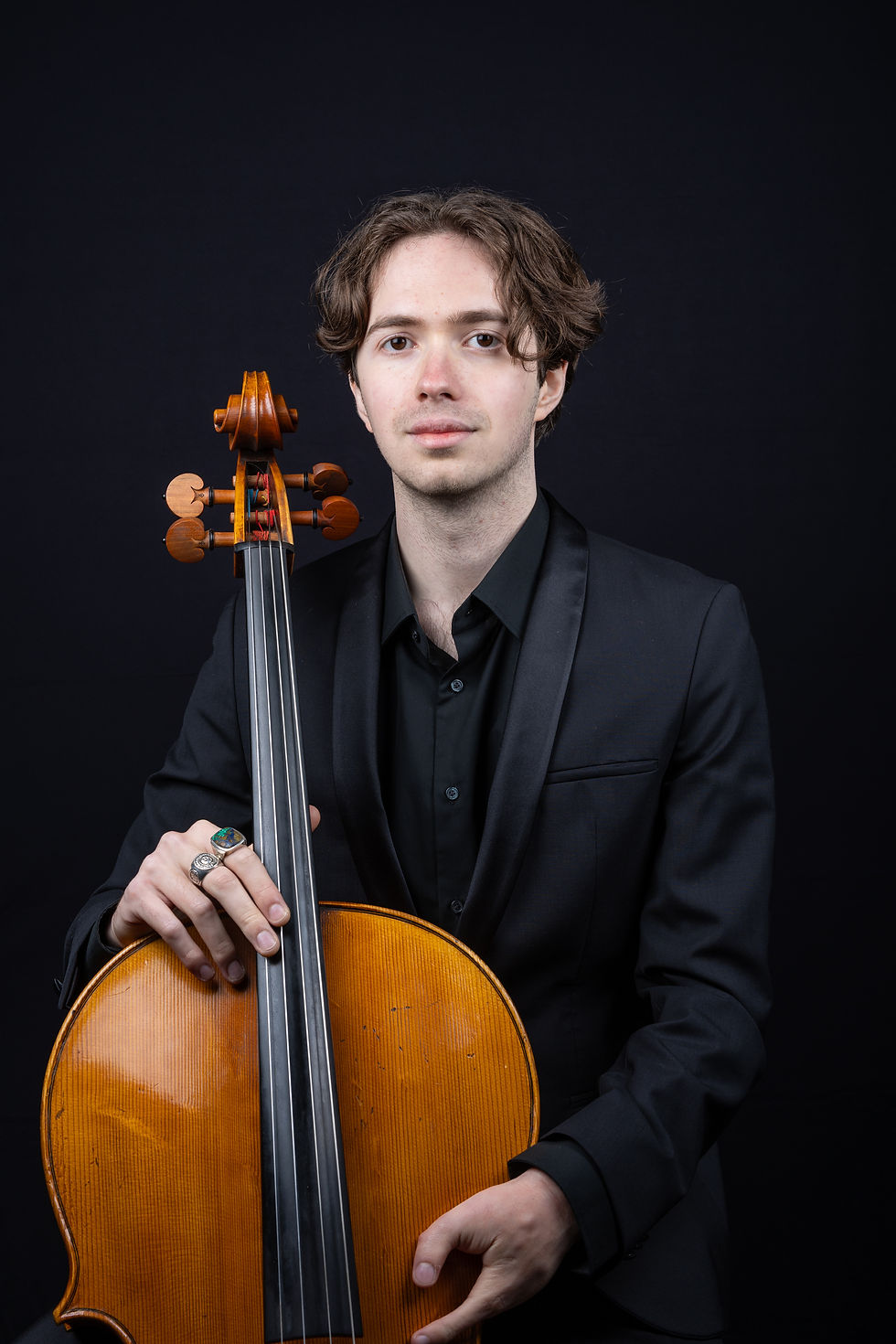
Over the years, Soni Siecinski has learnt to turn constraints into opportunities for exploration. Now a Master’s student at the CNSMDP in Raphaël Pidoux’s class, the young cellist—who was born with a deformity in his left hand—is juggling a busy musical schedule whilst pursuing a project that is as personal as it is ambitious: the design of a new prosthesis intended to revolutionise his playing, but also to provide him with greater comfort and freedom of movement.
Soni plays an inverted cello specially made for him in 2019, during the La Grange de Meslay festival, as part of an initiative by Talents & Violon'celles. The instrument was built under the leadership of Jean-Louis Prochasson, who brought together four other instrument makers for the project: Savine Delaporte, Joël Klépal, Antoine Lescombe and Virginie Pezet-Berton.
When engineering complements musical expression
For several months now, Soni has been working with a team of engineers from the Centre for Studies and Research on Assistive Technology for People with Disabilities (CERAH), a partner organisation of the Hôpital des Invalides specialising in assistive technology and adapted devices. Following an initial research phase carried out with the e-Nable association, known for its 3D-printed prosthetics, the project has taken on a new dimension thanks to the expertise of two engineers, Quentin and Denis.
“They came up with solutions that we hadn’t thought of in over a year and a half of research,” explains the musician. Together, they are developing a prototype that is lighter, smoother and, above all, adaptable to different bows — a crucial step towards giving the cellist greater freedom in their playing.
For the stakes go far beyond mere technical comfort. The research focuses on the precision of the movement, the control of the bow’s weight, the opening of the arm, the mobility of the wrist and the subtlety of the tonal nuances. “I can already feel a huge difference,” says Soni. “The sound is more open, more free, with greater resonance.”
The prosthesis, which is still at the experimental stage, nevertheless requires numerous adjustments before a final version can be produced. Every modification involves a process of relearning muscle control and technique. Finding the right angle, the right position and the right point of support takes time — and a great deal of self-reflection. “We’ll never know if there’s a perfect position. At some point, you have to choose the best possible one and build on that.”
Aware of the physical risks associated with this change, the musician has also started a rigorous strength-training regime to prevent injuries and tendonitis. “I’m discovering muscles I’ve never really used before,” he says matter-of-factly.
A wide range of artistic projects

Alongside this technological research, Soni is pursuing a particularly varied course of study at the CNSMDP. In addition to his Master’s degree, he is undertaking several complementary courses: chamber music, a bachelor’s degree in string quartet performance with his Arev Quartet, teacher training as part of the State Diploma, as well as orchestral work with the Appassionato Orchestra.
The past few months have also been marked by a number of significant artistic projects. Invited to MIDEM in Cannes in February 2026, he performed in the main auditorium of the Palais des Festivals as part of the programme focusing on disability and artistic diversity. More recently, he took part in the 7th episode of La Balise, ‘Les corps valides sont éphémères’ (Able bodies are ephemeral), recorded at the Philharmonie de Paris, alongside artists and speakers committed to issues of inclusion.
A voice to raise awareness and inspire
Beyond the stage, Soni now wishes to develop another aspect of his career: public speaking. Through lectures, talks and TEDx events, the musician is exploring ways to share his experience and perspective on disability, creativity and adapting musical expression. “Music gives me this visibility, and that visibility can also benefit music,” he sums up.

Combining technical innovation, artistic rigour and a commitment to passing on his knowledge, Soni’s career exemplifies a profoundly contemporary approach to the profession of musician: inventive, open-minded and resolutely forward-looking.


Comments